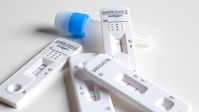
Access to four complimentary home-based Covid-19 antigen tests can now be secured through the website COVIDTests.gov, marking the commencement of the seventh phase of the federal government's initiative to distribute tests widely. Despite the recent launch of this distribution cycle, lasting merely a month, there have been reports indicating that some of the tests are close to their expiration dates. While it might be tempting to discard these tests or other Covid-19 home test kits that appear to be nearing their expiration, the US Food and Drug Administration (FDA) advises individuals to consult its website for possible extensions, potentially preventing the unnecessary disposal of still-effective tests.
These antigen tests, colloquially known as rapid tests, are designed to detect specific proteins, or antigens, from the SARS-CoV-2 virus, which causes Covid-19. They offer the convenience of providing results within minutes, right in the comfort of one's home. The FDA defines the shelf life of a test as "the duration for which the test is expected to function as intended, calculated from the date of manufacture." The expiration date, on the other hand, is "established at the end of the shelf life and represents the final date by which the test is anticipated to maintain its accuracy as it was at the time of production."
Dr. William Schaffner, a professor of infectious diseases at Vanderbilt University Medical Center, suggests that certain Covid-19 tests may continue to operate effectively for up to a year beyond the expiration date indicated on their labels, provided they have been stored appropriately. "As long as the tests have not been subjected to severe mistreatment, such as prolonged exposure to sunlight or other forms of damage, they should still be reliable," Schaffner stated. He also noted that test manufacturers determine these dates through rigorous laboratory testing.
"Manufacturers produce the tests and store them, periodically retrieving them at intervals of two, four, six months, and so on, to assess their performance and ensure they continue to function as intended, thereby providing the FDA with the necessary assurance of their efficacy," Schaffner explained.
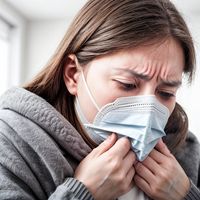
Experts suggest that individuals should consider taking a Covid-19 test if they exhibit symptoms such as coughing, fever, difficulty breathing, and fatigue. Given the similarities in symptoms among various respiratory infections, it can be challenging to diagnose the specific cause of illness. The FDA recommends multiple rapid tests for confirmation: two negative tests for symptomatic individuals and three for those asymptomatic, with each test administered 48 hours apart.
Medications like Paxlovid can alleviate Covid-19 symptoms, while Tamiflu is effective in treating the flu. These drugs are most beneficial when taken promptly after the onset of symptoms, underscoring the importance of testing at the first sign of illness. "The respiratory tract, including the nose, throat, and bronchial tubes leading to the lungs, are relatively simple organs," Schaffner said. "They tend to respond similarly to most respiratory viral infections. These viruses can all cause common cold symptoms, which can then escalate into more severe manifestations."
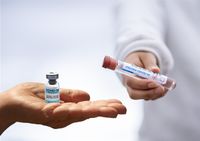
As the respiratory virus season approaches, experts advocate for receiving Covid-19, flu, and RSV vaccinations, if eligible, in the fall to ensure protection during the peak season from December through March. The US Centers for Disease Control and Prevention (CDC) advises that everyone six months of age and older should receive a 2024-25 Covid-19 vaccine and an updated flu shot. RSV vaccination is recommended for individuals aged 75 and older, as well as those over 60 who are at a higher risk of severe illness.
These vaccinations expose the immune system to these pathogens, reducing the likelihood of serious illness if contracted. "Vaccines function by preventing severe disease," Schaffner said. "Patients may complain about milder infections, saying, 'I was miserable for four days. I wouldn't call that mild.' We understand your discomfort, but we're glad you didn't have to experience the more serious consequences of our hospital care."

By Ryan Martin/Nov 6, 2024

By Christopher Harris/Nov 6, 2024

By Emma Thompson/Nov 6, 2024

By James Moore/Nov 6, 2024

By Samuel Cooper/Nov 6, 2024
By Daniel Scott/Nov 6, 2024

By Noah Bell/Nov 6, 2024

By Benjamin Evans/Nov 6, 2024
By Elizabeth Taylor/Nov 5, 2024

By Thomas Roberts/Nov 5, 2024
By Emily Johnson/Nov 5, 2024

By Eric Ward/Nov 5, 2024

By Megan Clark/Nov 5, 2024
By James Moore/Nov 5, 2024

By Lily Simpson/Nov 5, 2024

By John Smith/Nov 5, 2024

By George Bailey/Nov 5, 2024

By Sophia Lewis/Nov 5, 2024

By John Smith/Oct 29, 2024

By Christopher Harris/Oct 29, 2024